How partner award bookings work
This year we've seen devaluation after devaluation, all making it more difficult for us maximizers to get outsized value from our points. Obviously the best of the best redemptions are slowly disappearing, but there's still plenty of value out there! In this post I'll go over how partner award bookings work, and how using these partners can get you outsized value.
Partner Airlines
If you aren't already familiar with alliances and airline partners, I would highly recommend you spend some time and read up on how they work. In essence, they allow airlines to book tickets on other airlines that are not their own. So you don't necessarily have to book a United ticket on United as there are other options available throughout Star Alliance (or even Jetblue).
The three big alliances you need to know are:
- Star Alliance (shorthand *A) - includes United, Lufthansa, Swiss, Turkish, Air Canada, etc.
- OneWorld Alliance (shorthand OW) - includes American, JAL, Qatar, British, etc.
- SkyTeam Alliance - includes Delta, Air France-KLM, Aeromexico, Virgin Atlantic, Korean, etc.
In addition to alliances, airlines have have partnership agreements with other, otherwise non-affiliated, airlines. This includes random partnership pairs like Jetblue-United, Southwest-Icelandair, AA-Aer Lingus, etc.
With the power of alliances and partnerships, you can buy one singular ticket that goes way beyond one airline's reach. Want to go from the US to a random small airport in Thailand? No problem! You might connect on 4 different airlines, but you'll get there seamlessly on one ticket. But these partnerships also unlock a world of possibilities with travelling on points.
When you're using your points, remember these partnerships!
Fare Bucketing
To really understand the full scale of how airline pricing works, you'll need to get into fare bucketing and blocked space categories. Take cash prices on a flight for example - as tickets sell, lower fare buckets disappear, which leads to higher and higher airfares. When the flight is almost empty a month out, airlines sell tickets at a very low price in the lower buckets. When the flight is 99% full a week out, airlines sell the last tickets at a very high price in the highest buckets.
For award flights, keep in mind one phrase - the cheapest award fares are placed into a "Saver Award" bucket. Similar to the cheapest cash prices, as the flight fills up, award seats become either more expensive (when using dynamic pricing) or fewer seats are available at the same price (when using fixed pricing).
The last-minute booking
But here's the interesting thing - flights are almost always much more expensive right before departure because last-minute ticket buyers often urgently need to fly. So even if a plane is completely empty, airlines typically won't sell tickets for super cheap. But in contrast, award tickets are the exact opposite. Awards are often cheaper immediately before departure. The logic is that the seat would otherwise go out empty, so it's better to make some money from it than none at all.
This is how I often score long-haul Business Class seats within 14 days of departure. As airlines realize seats likely won't sell for cash, they release to their award programs for the lowest Saver buckets.
There's two common strategies to scoring award flights - either book immediately as the schedule opens up (around 360 days before departure) or book super close before the departure date (less than 14 days before departure). I personally do the latter - I have no clue what my plans are a full year out! But if I'm free one week, I'll choose my itinerary and flights then.
How partner airlines see "Saver Awards"
There's another layer to the Saver Awards discussion. Say that United releases 10 tickets EWR-SFO 10 days before departure at the Saver rate of 15k miles. United may choose to reserve most of these tickets exclusively to MileagePlus members with a credit card and only 2 seats available to external partners. So if you're booking the flight through Aeroplan, you'll only be able to book 2 while MileagePlus members can book 3+ tickets.
We've seen more and more airlines restrict award space to their own program members (United is the biggest example of this). They want to encourage their own members to redeem their own miles, which hopefully boosts loyalty and profits on their own airline. They also might not be compensated 1:1 for award flights booked on partner stock.
Long story short: if you see a partner award booking on a different program, that is typically OK to book. But if you see an award booking on the same airline, double check with a partner first to see if the ticket is available externally.
Examples
Partner availability
Say I'm searching for a flight from BOS to VIE about a week in advance. United charges a flat 88k miles for partner bookings in Business from the US East Coast to Europe.
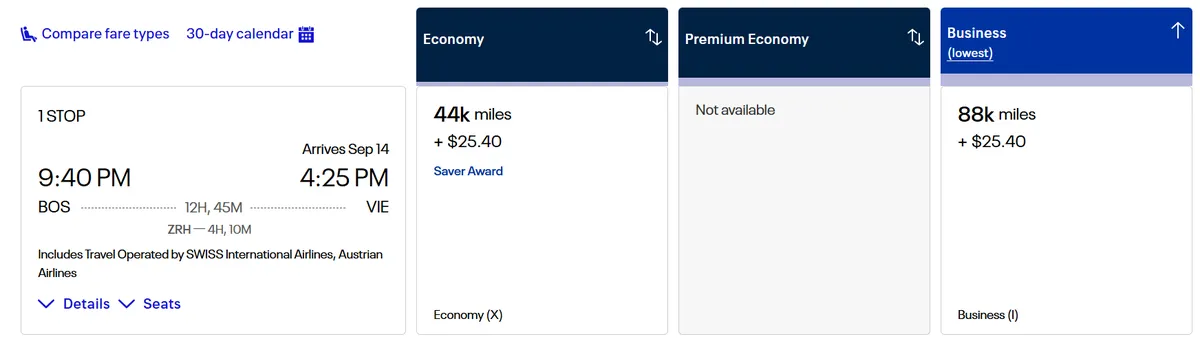
See? United is issuing the ticket, but the flight is operated by Swiss. This is an example where Swiss has released a few empty Business Class seats to partners, and United can book these seats through their program.
Now take another example from the US to Japan (which is one of the most popular travel destinations right now due to the exchange rate). AA charges over 100k to fly their own product (under dynamic pricing rules) through DFW, but charges only 60-80k to fly partner airlines between the US and Asia. Isn't that weird?!
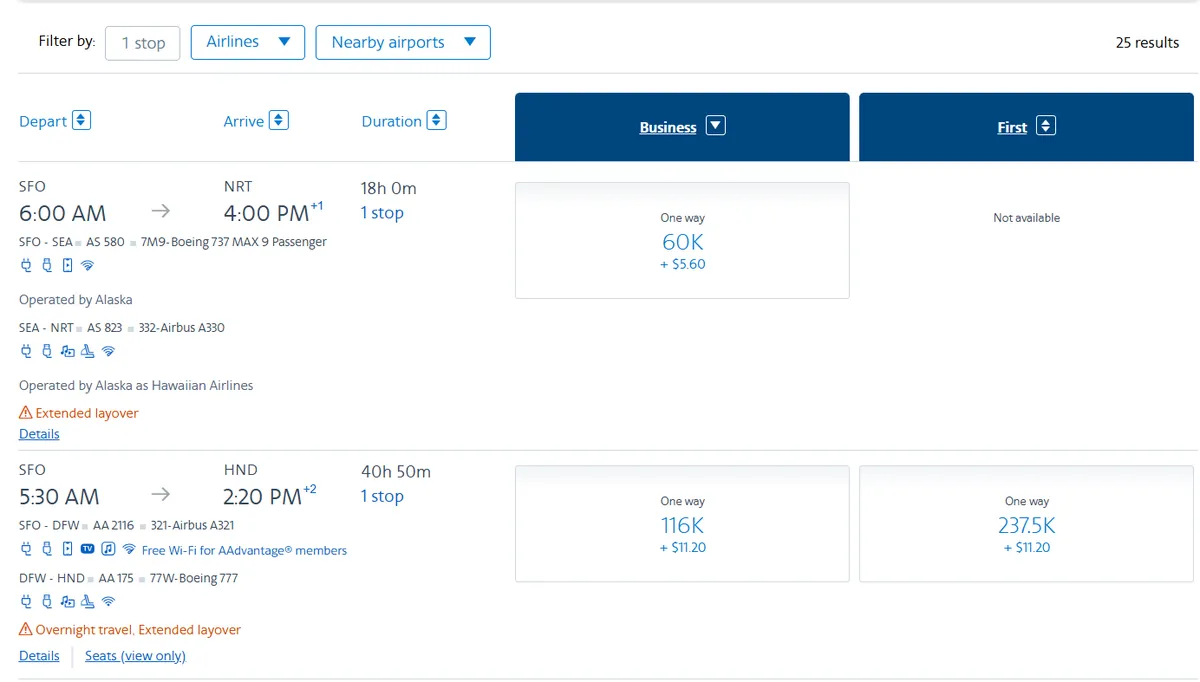
Or you could fly JAL, which has a MUCH better product than either AA or AS:
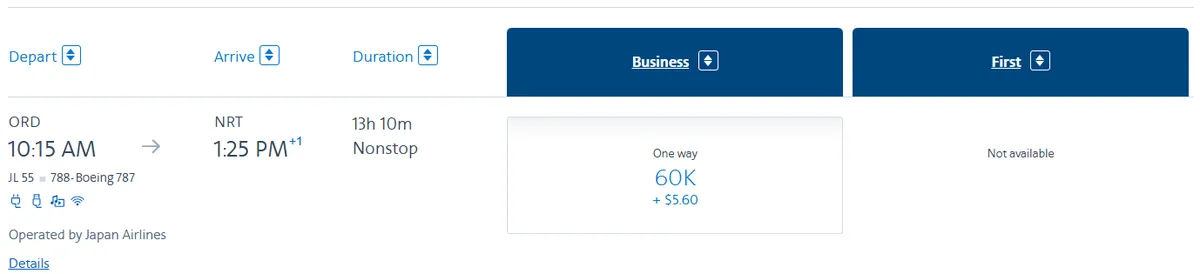
Like the United example, this means that Alaska and JAL have released the empty seats to Saver awards and partners can see the space. You can book this ticket through AA stock and pay the lower price. You can even book this ticket through other partners like BA, VA, Qatar, etc., but each program prices partners differently and you'll often pay more miles for the same exact seat.
Same-airline availability
Let me dive into a few examples where the source airline reduced prices but didn't release to partners. Since United is the biggest offender here, I'll use them for this exercise.
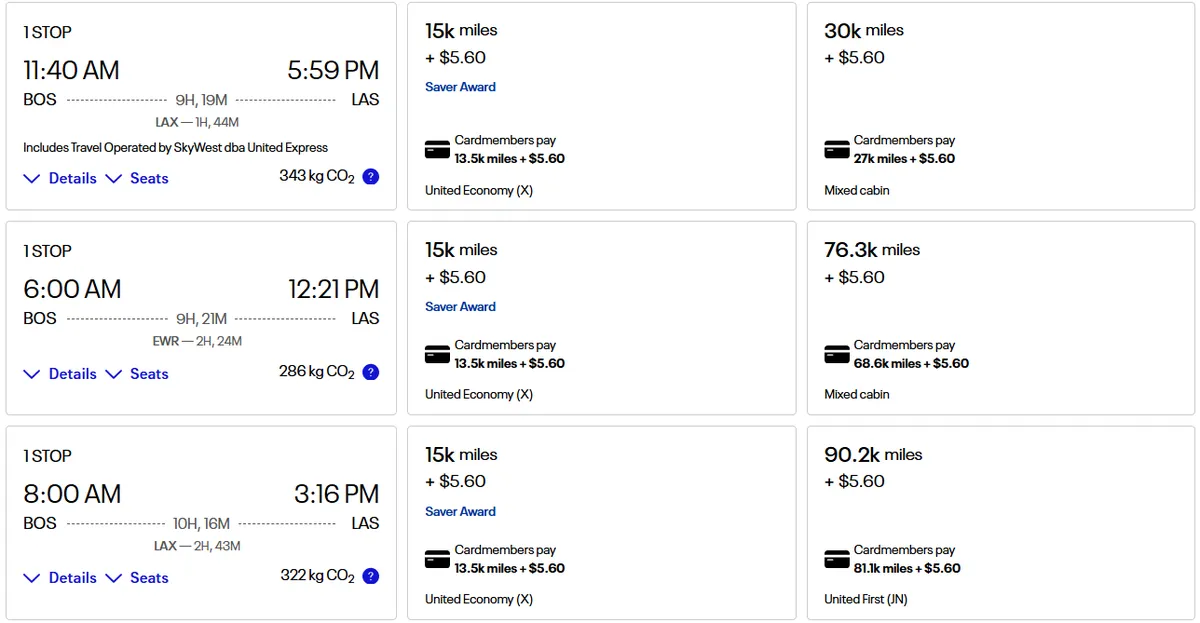
Say I'm searching for an Economy ticket from BOS to LAS about a week out. I can see that United is selling a ton of seats through different connections:
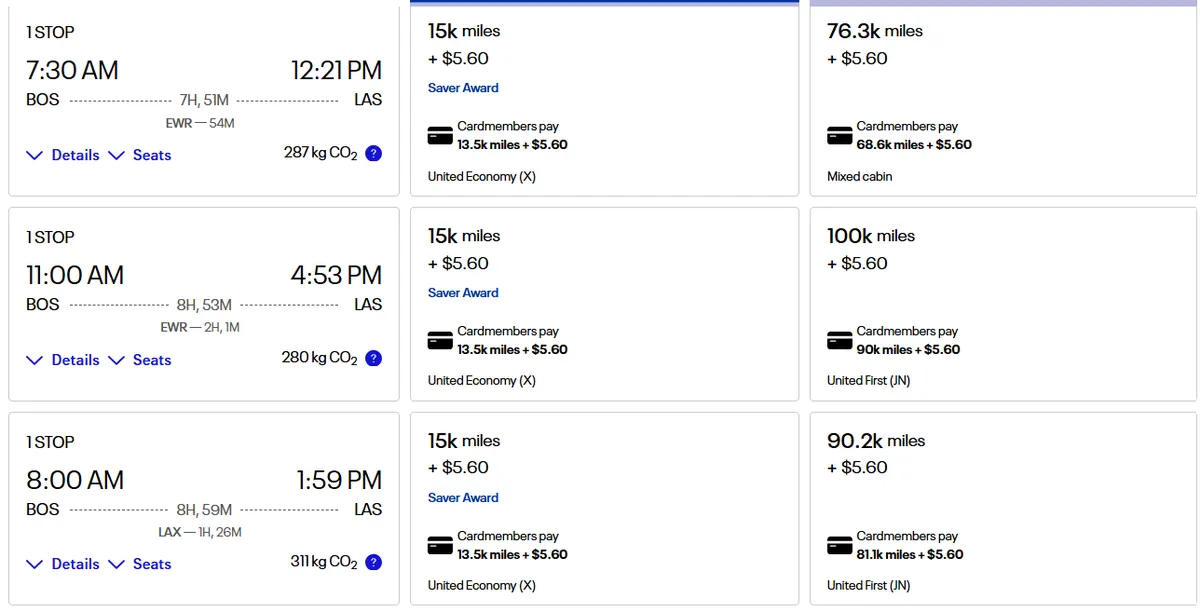
But when I search through partner airlines like Turkish, only one option comes up:
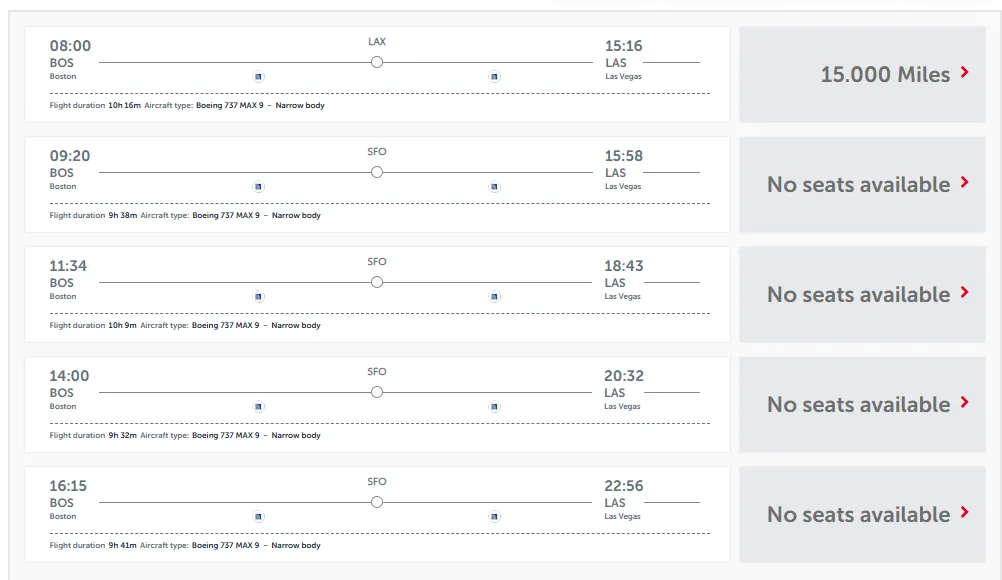
All the other flights are basically invisible to Turkish. This means United is restricting the Saver Awards to its own members and only releasing the 8AM flight to partners. Note that I didn't even include cardholders and elite status members into this equation. Definitely a unique practice here and really makes it harder to book elsewhere.
I've written about how Turkish was the best way to book United flights in Economy in the past. But even Turkish now charges 15k miles domestically, which eliminates any reason to book with them. Their IT sucks, their customer service is useless, and they charge exorbitant fees to cancel award tickets.
If I wanted to book a flight that's a pretty short distance, I would consider using Aeroplan because the price is only 10k miles (obviously I would have to compare it against United and see if it's more than 10k or not). Alternatively, I would consider Aeroplan if a transfer bonus that gives bonus free miles. There's a 20% transfer bonus live until the end of September 2026 that you can take advantage of for an even bigger discount. A 15k mile flight would only cost 12,500 miles (though realistically you'd have to transfer over 13k.
Otherwise, I would only consider booking with Aeroplan if I didn't already have Chase points or United miles. Aeroplan is a transfer partner from every major points currency. It unlocks booking sub-$200 flights anywhere in the US in standard Economy (not Basic Economy) by using Chase, Amex, CapOne, or Bilt points.